Sunday, October 27, 2019

About Miss EOLA Way #EolaNamesake


About Orlando’s MISS EOLA
A SPECIAL EDITION BLOG
For attendees of Fiesta in the Park at Lake Eola
November 2nd & 3rd, 2019

Perhaps while strolling around Lake Eola - enjoying all the unique creations of the artists - your own creative juices might ponder how this lake got its unusual name. #EolaNamesake is pleased to provide you with the answer.


Orlando Lakes: Homesteaders & Namesakes by Richard Lee Cronin, (2019) is an encyclopedia style history that traces the origins of 19th century named lakes in and around central Florida. Orlando’s iconic Lake Eola, named in 1874, is one of 303 Citrus Belt lakes included in my book. From Lake Eustis and George in the north, to Lake Conlin and Tohopekaliga in the south, the origins of most 19th century named lakes were found in official documents recorded at the 1857 Orange County seat at Orlando. Hence the title, Orlando Lakes.

Each lake is presented in alphabetical order in the book, with Lake Eola featured on Page 91. The lake’s description however is included below for curious attendees of Fiesta in the Park.


(Lake Eola is also featured on the cover of the book as shown above.)

A perfect holiday gift for the history fan in your family

Special Event Price of $18.00 for an autographed copy

Page 91 of Orlando Lakes: Homesteaders & Namesakes
EOLA
Section 25 22S; 29E (Downtown Orlando)

Florida Cattle-King Jacob Summerlin moved his family back to Florida in the early 1870s. They had relocated to Liberty County, GA after the Civil War, moving there so the children could get a better education. Moving back to Florida brought the Summerlin family to Orlando, where the cattle king purchased 200 acres adjacent to the four (4) acre village of Orlando.

A son Robert, having graduated from law school in 1875, attended along with his father Orlando’s 1875 incorporation meeting. During the meeting Summerlin property, 200 acres adjacent to the east side of the village, was annexed into the Town of Orlando. Jacob subdivided his land that same year, sketching a plat in 1875 which showed a named Lake Eola.

An unusual name, Orlando’s iconic Lake Eola of today dates to the arrival of Jacob Summerlin in 1874. Historian and author Kena Fries said in 1938 that prior to Jacob Summerlin’s arrival, the lake had been known as "South Beach". Kena also said Summerlin chose the name at the request of his son Robert. According to Kena, Robert Summerlin and a girl named Eola had been sweethearts. They planned to marry, but Eola died within weeks of their proposed wedding. So, is any of this true?

Native Floridians, the Summerlin’s had lived in Georgia only a brief time. After arriving in Orlando, Jacob Summerlin’s wife attended a meeting too, her's to help organize a Presbyterian Church. One of eleven original church members, March 18, 1876 minutes reads as follows; “Mrs. Jacob Summerlin, formerly of Flemington, Georgia, was in attendance.”

Flemington, GA, southwest of Savannah, is in Liberty County, GA. The Summerlin family was listed in that county’s 1870 census as family #13. The Summerlin children were listed as: George, Robert, Samuel and Alice, and all were said to be “attending school.” A neighbor in 1870, family #6, was Widow Sarah A. Way. Residing with her was a daughter Florence, age 23, listed as a schoolteacher, and three other children, each attending school as well: EULA, Ellen and Joseph.


Lake Eola c. 1880s from downtown Orlando by Stanley J. Morrow

EULA was more formerly Eulalie Way, born at Liberty County, July 22, 1854. But Eulalie never married! She died at age 42, October 13, 1896, and was buried in the State and County of her birth. At age 6, EULA was listed as Eulalie, but 10 years later, as a young girl, friends apparently had nicknamed her EULA. In 1870, "Eula" was 16 years old, Robert Summerlin was 12.

Till Eulalie became my blushing bride:” Eulalie was a popular name back in the mid-1800s (see Maitland’s Lake Eulalie), popular because of an Edgar Allan Poe poem that had been released nine years before Eula’s birth. The poem, “Eulalie,” is said to be verse about the author’s wife. Married in 1836, a line of the poem reads: “I dwelt alone, in a world of moan, till the fair and gentle Eulalie became my blushing bride”.

Robert Summerlin and Eulalie Way never married, but not because his "to-be bride" had died. Robert may have had a crush, and it seems the Summerlin boys asked dad to name the lake on their property for their Liberty, GA school chum, Eula Way. But how then did Eula become Eola?

Early surveyors were detailed mapmakers, but often terrible spellers. Fort Reid, named for Florida Territorial Governor Robert R. Reid, was printed Reed by surveyors in 1846. Historians perpetuated that error. Lake Jesup is still misspelled Jessup to this day. Jacob Summerlin hired a surveyor in 1874 to plat his addition to Orlando, and apparently, when told to name the lake Eula, and unaware of Edgar Allan Poe’s poem, Surveyor James Jefferson Davis printed Eola instead.

LEGEND Pg. 14: 1881P00C068

END OF LAKE EOLA SECTION OF ORLANDO LAKES


Grave of Eulalie Way (1854-1896) Liberty County, GA

Central Florida history
Richard Lee Cronin
Website CroninBooks.com
Email Rick@CroninBooks.com

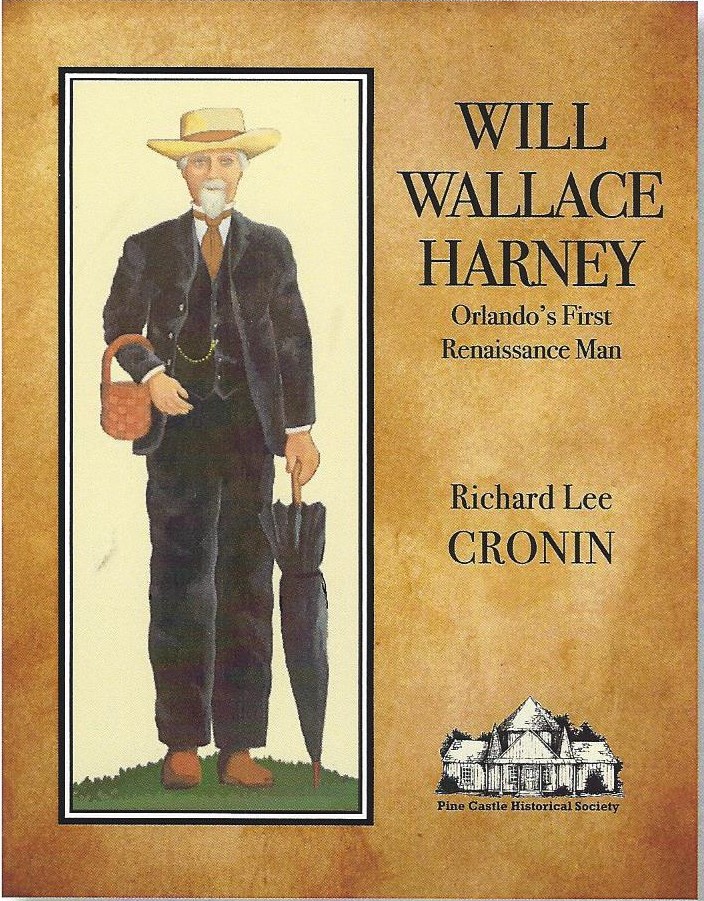
Will Wallace Harney, Orlando’s First Renaissance Man: Commissioned by Pine Castle Historical Society, this is the first-ever comprehensive biography of central Florida’s distinguished pioneer and Pine Castle founder. More than a biography of one notable individual, this book describes the origins of Florida’s Citrus Belt itself. Proceeds benefits the Historical Society’s ongoing Pine Castle preservation projects.

Pick up your autographed copy at Fiesta in the Park
CroninBooks booth in the Central Blvd Quadrant

Orlando Lakes: Homesteaders & Namesakes: Name origins of 303 central Florida lakes identify the area’s earliest homesteaders and why they gave lakes the names we know them by today. From Lake Eustis in the north to Lake Tohopekaliga in the south, 19th century records were kept at the then county seat of Orlando.

The Rutland Mule Matter: A central Florida Civil War Historical Novel based on a true-life Orange County family during the aftermath of America’s War of Rebellion. A son and daughter search for their missing father, banished from local history after the War. Quite possibly the only Novel that includes a bibliography! The siblings find the answer they sought – but that knowledge changed everything. Seven Honorable Floridians compliments Rutland, offering biographies of all seven Florida Secession Convention delegated who voted NO!

Beyond Gatlin: A History of South Orange County. Recipient of Pine Castle Historical Society’s 2017 Historian Award, Beyond Gatlin tells of the pioneers and their settlements south of Fort Gatlin, including towns: Troy, Gatlin, Pine Castle, Mackinnon, Kissimmee, Smithville, Runnymede, The Prosper Colony, Taft, Belle Isle & Edgewood. Beyond Gatlin is a perfect companion to Will Wallace Harney, Orlando’s First Renaissance Man.

First Road to Orlando: A history of Fort Mellon to Fort Gatlin Road, established in 1838 as a military trail. For four decades this dirt path was the main artery for settlers coming inland to Orlando. Today’s I-4 corridor developed largely along this path – a trail that in 1870 was used to plan the route of central Florida’s first railroad. Includes analysis of each old-time version of how Orlando was named – and one new version based on facts.

CitrusLAND: Ghost Towns & Phantom Trains: Ride along with real-life Edward T. Stotesbury and John P. Ilsley – two Philadelphians who had attempted to rescue the Orange Belt Railway in the 1890s. Boarding at Sanford days after the freeze of 1894-95, you’ll meet real-life homesteaders, men and women, who founded: Sylvan Lake; Paola; Island Lake; Glen Ethel, Altamont (Palm Springs); Forest City; Toronto; Lakeville; Clarcona; Crown Point; Winter Garden and Oakland. History in Novel form complete with bibliography.

CitrusLAND: Curse of Florida’s Paradise: Central Florida’s earliest pioneers faced every imaginable challenge, and many unimaginable, while attempting to tame a remote Orange County wilderness. Each of twelve chapters begins with a biography paying tribute to a central Florida frontierswoman, partners with the remarkable male counterparts who – against all odds – established Central Florida’s Citrus Belt.

In His Brother’s Memory: No history! Escapism in the form of a suspense Novel which takes place on the streets of Paris. a Novel added to the family of R. L. Cronin Books in 2018.


History, Mystery & Intrigue

CroninBooks pays the Florida Sales Tax on ALL Event Sales - Tax included in price


Friday, August 23, 2019

First train to LAKELAND


First train to LAKELAND

A full-page March 12, 1890 advertisement in the Florida Agriculturist newspaper reads much like a history of the victorious town in a battle between two place names. Last week’s blog told of a Lake Parker town of Acton, now little more than a ghost town. A few miles west of Acton a fellow named A. G. Munn laid out his town of LAKELAND, the winner in the battle between the two towns, and in 1890, Munn was selling the Tremont Hotel at Lakeland, said to have been built, per the full-page advertisement, “in the Fall of 1884, enlarged during the Winter of 1885-86, and thoroughly repaired and repainted in February 1890.”

Abraham Godwin Munn (1819-1909)
Abraham Godwin Munn (1819-1909), of Louisville, Kentucky, founded Lakeland on 80 acres he purchased in 1881-82. President of an Agricultural equipment manufacturing firm at Louisville, Munn originally selected DeLand as the site for his winter residence, arriving there, reported the Florida Agriculturalist, March 2, 1881. The paper wrote that Mr. Munn of Louisville “invested largely in the fine residence on the place he purchased from Dr. Lancaster.” The residence had presumably been the home of Dr. George W. Lancaster (1836-1913), an early DeLand pioneer.

Munn kept his property and interest in DeLand, for in 1889, he was listed as a partner in the St. Johns and DeLand Railway Company, a venture desiring to build a line between Lake Beresford and DeLand. Abraham Munn’s son, Morris G. Munn, established a farm in the DeLand area.

Two other railroads however became of interest to Abraham G. Munn long before he invested in the short 1889 DeLand line. These two railroads were mentioned in Munn’s 1890 Tremont Hotel advertisement. “Lakeland,” the Munn’s ad stated, “is at the Junction of the South Florida and Florida Southern Railroads, and now has 11 passenger trains daily.” Lakeland was described in Munn’s advertisement as “beautifully laid out with wide streets and is the highest point on the South Florida Railroad line, and very desirable for a winter home.” Interested parties could buy the hotel of 36 guest chambers, said to have had 4,000 guests since first opening, at “a bargain, on easy terms.” Interested parties were encouraged to contact Morris G. Munn at DeLand.


Kentucky Avenue, Lakeland, circa 1880s, Munn Public Park at right
As viewed from the railroad tracks, courtesy Floridamemory.org

Abraham Munn, son of Ira Munn (1792-1857) and Elizabeth (Godwin 1796-1878), had been a native of New Jersey who relocated at a young age to Louisville, Kentucky. On November 13, 1844 Abraham married Rebecca (Morton). Other than spending winters in Florida – either at DeLand or his Lakeland property, Abraham did not move to Florida as a full-time resident. He died at Louisville October 18, 1909.

South Florida Railroad’s extensive 1887 travelogue described central Florida’s terrain heading west from Kissimmee, explaining how the grade ascended in terraces ranging from 65 feet above sea level near Lake Tohopekaliga to 210 feet at Lakeland. “An energetic settler and English company have cut 3 ½ miles of canal,” reported the travelogue, “and are engaged in redeeming these meadows, which will be astonishingly fertile.” One supposes the brochure might have been talking about Englishman Piers Eliot Warburton and his lakeside town of Acton (Last week’s blog).

The travelogue continued in his description: “Lakeland unites to its natural advantages and present opportunities as the junction of the main line and Pemberton branch of the South Florida Railroad, the prospective hope of drawing to it the associate lines of the West Coast.” East-West South Florida Railroad and north-south Florida Southern Railroad had both set their sights on Lakeland. “The town,” the travelogue added, “is more city-like than any point north of it, and is laid off about a main plaza forming a square of ten acres, with the railway extending along one thoroughfare.”

The main plaza was that of today’s Munn Park (outlined in green below on the early plat of A. G. Munn’s Town of Lakeland. The red line indicates the path of South Florida Railroad.)


A.    G. Munn’s 1884 survey of his town of Lakeland

Of each description of Lakeland, and for most every town in this vicinity for that matter, is that “it is hard to believe the babe born the day it was incorporated is yet in long clothes; or that four years ago there were more wild cats and panthers than men and women in the city.” Abraham G. Munn acquired his land only four years before the arrival of the Lake Monroe to Tampa Bay train.

There is far more to the story of Lakeland’s founders and founding, a history requiring its very own blog series, but for now – in the interest of telling how a train to Tampa Bay influenced the development of central Florida – suffice it to say that Abraham Godwin Munn envisioned the town of Lakeland, a city he first platted in 1884.

This blog series resumes next Friday as the South Florida Railroad continues to lay down track toward the Gulf of Mexico. Next Friday we enter Hillsborough County, stopping first at Plant City.


CroninBooks.com YOUR online central Florida history store

Friday, August 16, 2019

First train to ACTON of Polk County


ACTON: Sister city of Mackinnon of Orange County & Sarasota, Florida

“For a short time,” according to Lakelandgov.net, the city of “Lakeland had a rival town on the south side of Lake Parker, the largest lake in the city. That town was called ACTON. It had a church before Lakeland did, and more importantly, a railroad depot.” The railroad depot was a stop the South Florida Railroad line.

Origins of three sister Citrus-Belt cities: Sarasota, Mackinnon and ACTON, date to the four (4) million acres Philadelphian Hamilton Disston acquired in the early 1880s. That land deal allowed the State to settle its pre-Civil War debt, thereby freeing up public lands for use in encouraging investors to build railroads. The Disston investment resolved the Vose injunction which had been in place since 1870, and immediately increased the desirability and value of South Florida land.

With the court injunction settled, Hamilton Disston recovered a portion of his large investment in Florida by selling chunks of his 4 million acres to other land speculators. An English consortium became one of the speculators, a group who organized themselves as The Florida Mortgage & Investment Company Limited. Two of the named English officers of that company were Robert W. Hanbury and Piers Eliot Warburton.

Hanbury and Warburton appeared in Orange County by April 1883. That August, a one-square mile town of Mackinnon was laid out in South Orange County, north of Kissimmee. A depot on the South Florida Railroad line was built at Mackinnon, where Florida Mortgage & Investment Company began selling lots in their new Town of Mackinnon.


Sir William MacKinnon, namesake of
Town of Mackinnon is featured in my 2017 book;
Beyond Gatlin: A history of South Orange County
Visit CroninBooks.com for details

Meanwhile, Piers Eliot Warburton represented Florida Mortgage & Investment Company at Sarasota. A historic marker at the Five Points intersection in downtown Sarasota tells of how, in the spring of 1885, a surveyor for Florida Mortgage & Investment Company laid out the town. Piers Warburton however didn’t concentrate only on Sarasote. That very same year, Webb’s Historical, Biographical & Industrial magazine reported that Acton, Florida, in Polk County, had a railroad depot at city center as well as two hotels – Acton House & Lake House on Lake Parker. The land agent at Acton, said Webb’s, was Piers E. Warburton.

John Dalberg-Acton (1834-1902), aka Lord Acton of England, as described by the Acton Institute of Grand Rapids, Michigan, was “the magistrate of history.” Among the well-known personalities of the 19th century, says the Institute, one of Lord Acton’s quotes attributed to the man is the oft used: “power tends to corrupt and absolute power corrupts absolutely.”

Lord Acton was the grandson of Sir John Acton (1736-1811), celebrated commander of the British Naval forces. Piers Eliot Warburton had been a Lieutenant in the Royal Navy prior to crossing the big pond to represent English investors in the United States.


Winifred Hodgeon arrived at New York a single gal August 23, 1886. Leaving England with her mother at the age of 19, Winifred settled first at Orange County, where she began acquiring land. In 1889, Winifred married Piers Eliot Warburton, and the newlyweds settled at Acton, the new city in Polk County developed by English investors.


Piers Eliot Warburton, Winifred Ann (Hodgeon) and sons

“To show what ladies can do in Florida,” reported Weekly Floridian on June 7, 1888, “Mrs. Logan, of Acton, has growing on her place oranges, lemons, figs, guavas, peaches, bananas, grapes, pineapples, strawberries, citrons, Brazilian papaws and Scuppernongs.” The town founder by Piers Warburton made the news again August 6, 1889: “Sir Francis Osbourne, a genuine English nobleman who has more title than money, is working in a sawmill at Acton at the rate of one dollar a day.”

The merger through marriage of Piers Warburton and Winifred Hodgeon consolidated large landholdings that stretched from South Orange County and Polk County. Winifred had acquired scattered parcels west of Mackinnon, including a large parcel that is now part of Disney’s Magic Kingdom.

Piers Eliot & Winifred Anne (Hodgeon) Warburton returned to England after Florida’s Great Freeze of 1894-95. Like so many other central Florida pioneers of the 19th century, their land became worthless as dead citrus trees littered the route of South Florida Railroad. Eventually their long-abandoned property was sold for unpaid taxes to the next generation of speculators, firm such as Munger Land Company of Missouri.

Piers Warburton at England died in 1927. His Florida bride of 1889 survived him, living in England until her death in 1954.


South Florida Railroad in Polk County before towns Acton & Lakeland

The Acton railroad depot, says Lakelandgov.net, burned down “under mysterious circumstances, and a new depot was built in Lakeland. Acton began to decline and was gone by 1906.” But Acton was not the only South Florida Railroad ghost town. Mackinnon of Orange County also fell to ghost town status. One of the three sister cities in which Piers Warburton played a role in developing however did survive and flourish. And today, Sarasota’s Five Points remains the hub of Sarasota, Florida.

This blog series resumes next Friday as the South Florida Railroad inches further west - to that next depot beyond Warburton’s town of Acton. Next Friday, August 23, 2019, Lakeland, Florida.


CroninBooks.com - YOUR online central Florida history store


Friday, August 9, 2019

First train to AUBURNDALE


“In a cluster of a wild scenery of lakes, but on the broad hump among them, is pretty AUBURNDALE, laid out with curved and straight avenues, like the spokes and felloes, on concentric rays, so as to utilize the building sites.” (South Florida Railroad 1887)   


Lakes Stella (foreground) & Adriana (background) - Auburndale, FL

Not a lot could be said of Auburndale in the South Florida Railroad travelogue of 1887 because at that time the settlement was little more than an idea of a railroad pioneer having no connection with the firm laying down track across his homestead. As for the 1887 descriptive brochure, this region southwest of Kissimmee “was more well known by hunters, passing by park-like open pines, as free of undergrowth as a trimmed lawn, or by green coverts of the deer, and where the slender cougar lies in wait for the doe, at the watering places.”

Kissimmee City of Orange County – for several years the southernmost city in the United States having train service, became Kissimmee of Osceola County on May 12, 1887. Five years had already passed since Orange County correspondent Will Wallace Harney, representing the New Orleans Times-Democrat, journeyed 498 miles into the Florida Everglades, departing out of Kissimmee on a 14 day expedition down the Kissimmee River, crossing Lake Okeechobee, and heading west on the Caloosahatchee River to the Gulf of Mexico.

James E. Ingraham had been especially interested in Harney’s journey into the Everglades, for as President of South Florida Railroad, Ingraham planned to be aboard the second expedition a year later, a journey to be made in search of the best railroad routes in South Florida.

Available this FALL 2019
PINE CASTLE HISTORICAL SOCIETY
WILL WALLACE HARNEY
Central Florida’s Acclaimed Poet, Writer, Historian, Correspondent
To receive an email when the book is available for purchase, contact
NOTE: This book is being a publication and sold by the Historical Society.  


Harney had long advocated train service for central Florida’s citrus belt, writing of plans for a Lake Monroe to Tampa Bay train as early as 1871. He wrote on numerous occasions of attempts to connect the St. Johns River with the Gulf of Mexico, stating in one 1877 article, “If we could get a short railroad of a hundred miles or so connecting Orange with Tampa, it would add greatly to the advantage of both, and would build up Hillsborough County.”

Nearly a decade would pass before Harney’s prediction would prove to be true, but while Will Harney of Orange County was writing his October 1877 article, an Illinois doctor was making his way to Tallahassee, Florida with an idea of his own.

Dr. Hartwell C. Howard came to Florida in 1876 primarily for health reasons. Recovering from pneumonia, Florida’s climate had been what the doctor ordered. On November 20, 1877, Dr. Howard attended a board meeting at Tallahassee of Florida’s Internal Improvement Fund (IIF), a   committee established in 1855 for the purposes of improving Florida’s transportation. Chaired by Florida’s Governor, the IIF was a powerful committee, except when it came to approval of post-Civil War rail service throughout the state. (New York capitalist Francis Vose had been granted an injunction preventing Florida from using public lands to build rail service until his debt was resolved).

Minutes of the November 1877 IIF meeting offers insight into Dr. Howard’s idea: “Dr. H. C. Howard, on behalf of the Gainesville, Ocala & Charlotte Harbor Railroad, appeared before the Board and made a proposition.” Dr. Howard’s plan was for the state to sell his railroad firm, at five cents per acre, portions of public land on six miles on each side of proposed railroad line, with the stipulation that the sale would not “go into effect until the claims of Vose and others are settled.”

A group of Illinois investors, much like the folks in Orange County, were attempting to obtain approval to build a railroad in South Florida as early as 1877. Dr. Howard was the first President of the Charlotte Harbor bound train, a railroad that later became Florida Southern Railroad.


Auburndale Main Street, photo by Alice E. Kaszer (1890-1975)

Proud of their long-time doctor, Champaign County, Illinois has on file an 1887 biographical sketch of Dr. Hartwell Carver Howard (1829-1922), which says this of the good doctor: “He has heretofore been quite prominently identified with railroad interests.” Dr. Howard homesteaded 158 acres in Florida’s developing Citrus Belt, receiving a deed for the Polk County land dated March 20, 1885. Dr. Howard’s property was located on the southeast shore of Lake Ariana.

The 1887 biography of Dr. Howard offers a bit more insight on the man: “He has also been occupied in buying and selling Florida orange lands, having a town laid out on his own estate there, AUBURNDALE. He donated 80 acres of land to secure the South Florida Railroad through that town.”

It has been suggested, incorrectly, that Auburndale was originally SANATORIA, and that the town was founded by a Frank R. Fuller. As of 1887 however, both towns are shown on a Polk County map. The two separate settlements were nearly 2 miles apart.

Edwin Monroe Howard (1857-1930), eldest son of Dr. Howard, lived at Auburndale in 1900 with his wife, Belle (Brooks) Howard (1862-1939). Their next-door neighbor at the time of that year’s census was Ephram M. Baynard, a fruit grower, who in 1913 built his residence facing Lake Stella in Auburndale at a cost of $7,500, shown below courtesy Florida Memory project.


Built in 1913, The Baynard residence became Kersey Funeral Home

This blog series continues next Friday as the South Florida Railroad, under Henry Plant, continues to lay track in the direction of Tampa Bay. Next up, an Englishman lays out a town northeast of Lakeland – a town named ACTON.

YOUR online central Florida history store


Friday, August 2, 2019

First Train to KISSIMMEE


A train arriving at KISSIMMEE CITY in March of 1882 was a more important event in the story of central Florida than the arrival 16 months earlier of the South Florida Railroad at Orlando.


George M. Barbour, author of Florida for Tourists, Invalids & Settlers (1882), wrote of his first impression of the Orange County seat of government, describing it as “as old place, typical of the South. The ‘boom’ that has enlivened every other spot in Orange County seems to have left ORLANDO comparatively untouched.” The first train’s arrival at Orlando in late 1880 was an important event indeed in the county’s history. For nearly 40 years settlers and visitors had to trek a difficult sandy path 22 miles in length to reach Orange County’s courthouse square.

Further reading: First Road to Orlando by Richard Lee Cronin

But not until the railroad arrived at Lake Tohopekaliga was it possible for all of Orange County, present day Orange, Osceola and Seminole Counties, to reach its long-sought potential. “In June 1881,” wrote Sherman Adams in his 1883 Orangeland publication, “an extension was surveyed from Orlando, to Kissimmee City; the work commenced in July, and the road opened for business in March 1882.” The earliest architects of central Florida’s railroad corridor had gathered a dozen years earlier to jump-start the building of this much-needed train.
   
The first meeting of the ‘Upper St. Johns, Mellonville and Tampa Railroad’ had been held in March 1870 at Fort Reid’s newly opened Orange House Hotel. The planner’s railroad was to depart Lake Monroe heading south to Orlando, pass beside Lake Conway on its way to Lake Tohopekaliga, and then veer west toward Tamp Bay – almost the exact path of the 1880 South Florida Railroad.

Further reading: Beyond Gatlin, A History of South Orange County

An Orlando to Kissimmee City on Lake Tohopekaliga train began operating in March of 1882, and as the Orangeland publication reported: “During the summer a charter was obtained extending the road to Tampa, the route surveyed and a force of 1,200 to 1,500 men  employed, the Plant railroad syndicate taking a three-fifths interest in the road. So great is the energy displayed that the road is expected to be open to the public early in January 1884.”

The train to Kissimmee City not only made it feasible for the railroad to continue toward Tampa Bay, it opened as well south Orange County to development. Travel inland reduced strenuous day-long land journeys to a journey of only a few hours, while riding in the comfort of Pullman passenger cars. That which is thought of today as the I-4 corridor was born with the completion in 1884 of a Lake Monroe to Tampa Bay railroad. Orangeland of 1883 said it best: “The natural and customary gateway to Orange County is the St. Johns River steamers to Sanford on Lake Monroe, 200 miles south of Jacksonville, thence by the South Florida Railroad to the various towns along its line to Kissimmee City, forty (40) miles to the south. From the several stations conveyances can be had at reasonable prices to any point in the contiguous country.”

New towns sprang up around the stations along the train’s route: Gatlin; Pine Castle; Smithville (Taft); Mackinnon and Kissimmee. As the train’s route was extended westward, Campbell City; and Davenport were established as Orange County towns; followed soon after by a host of Polk and Hillsborough County upstarts, such as Plant City and Seffner. Trains solved central Florida’s challenging transportation problem – and in so doing – Orlando benefited as well.

Philadelphia’s Hamilton Disston made all the difference of course. In exchange for him paying off the State’s past due pre-Civil War debt, the successful saw-blade manufacturer was deeded four (4) million central Florida acres. His land was widely scattered, from Tarpon Springs and large chunks of Hillsborough County, to Pine Island in Charlotte Harbor and acreage near Pine Castle. His massive landholdings south of Kissimmee however is what he is most widely known for.

Hamilton Disston’s presence certainly encouraged establishment of Kissimmee, but the original town founders had been good ole Orlando boys. William A. Patrick, James P. Hughey, Surveyor Samuel A. Robinson and younger brother Norman, all teamed up in 1881 to expand upon what Robert & Rhonda Bass had established as their boarding house during the 1870s.


“The town of Kissimmee is situated,” wrote Adams in Orangeland, “at the head of navigation of the Kissimmee and Caloosahatchee rivers, and has direct water communication through these streams and Lake Okeechobee to the Gulf of Mexico. It has also railroad transportation northward, and in a few weeks from the issuing of this pamphlet will have railroad communication with Tampa on the Gulf Coast”.


Kissimmee remained part of Orange County until Osceola County was formed May 12, 1887, at which time the town’s importance as a transportation hub and tourist destination elevated it to being named the new county’s seat of government.

“If we could get a short railroad of a hundred miles or so,” wrote Will Wallace Harney in 1877, published that year in the Cincinnati Commercial newspaper, “connecting Orange County with Tampa, it would add greatly to the advantage of both and would build up Hillsborough County.” Harney, as it turned out, knew exactly what he was talking about.

To be continued....

This blog continues next Friday as the South Florida Railroad, under Henry Plant, begins laying track in the direction of Tampa Bay, while another railroader takes advantage of his land’s close proximity to found the town of AUBURNDALE.   

CroninBooks.com


YOUR ON-LINE CENTRAL FLORIDA HISTORY STORE              

Sunday, July 7, 2019

PINE CASTLE'S 19th Century Secret


UNRAVELING A MYSTERY OF HISTORY:
PINE CASTLE’S 19th CENTURY SECRET

An 1886 Pine Castle death became a mystery for the ages, a secret kept by the town’s citizens – a secret that over time was explained away by blaming Florida’s Great Freeze. Pine Castle’s death however had occurred nearly a decade before Florida’s worst-ever freeze of 1894-95, long after the body of Charles Goodspeed Nute had been laid to rest at Orlando’s Greenwood Cemetery. So why the secrecy about Nute’s death? What was Pine Castle’s 1880s secret? And was the very reason for residents at a hopeful new Orange County railroad town on the southern outskirts of Orlando, the decision to keep secret details of a May 26, 1886 death, proven to be justified?


Noah H. Grady House, Randolph Avenue
Courtesy Orange County Appraiser's Office

Answers to each intriguing question are revealed by fusing together histories of three residences of 1880s Pine Castle. Of the three 19th century homes however, only one still stands today, that being a residence on Randolph Avenue built in 1885 by Noah H. Grady. At times referred to as the “Founder’s House” and/or “Lancaster House,” this very parcel is jam-packed full of history. And this very parcel is also where the unlocking of Pine Castle’s secret of the ages begins.

Now located in the 20th century town of Belle Isle, the 19th century home built by Noah H. Grady was originally part of the Will Wallace Harney homestead. For a brief time in history, this home, which I will refer to as the Grady House from this point on, sat within a stone’s throw of the real Pine Castle – the home built by Will Wallace Harney a decade before Grady arrived. Harney’s Pine Castle residence is the second of three residences in our quest to unravel the 1880s secret of the town named Pine Castle.


A Missouri native, Noah Hamilton Grady arrived a single man at Pine Castle in 1884. He bought two acres from Pine Castle residents Isaac & Sally Aten on September 2, 1884. Said in the deed as being “a square,” the parcel Grady purchased was further described as located “on the east side of Randolph Avenue.”

Noah H. Grady was living at Pine Castle, with his parents Josephus & Serelda Grady, in 1885. He gave his occupation in the census of that year as “Law & Insurance.” Noah was again listed in the Orange County Gazetteer of 1887, a partner in Ormsby, Knox & Grady Insurance. Noah’s residence in 1887 was listed not as Pine Castle though, but Main and Magnolia in Orlando. (Noah’s partner, Collis Ormsby, had relocated, not surprisingly, from Louisville, Kentucky, the prior homeplace of Will Wallace Harney.) After 1887, Noah H. Grady vanished from central Florida, and history mistakenly recorded his departure as the result of Florida Great Freeze of 1894-95.

Noah married Annie L. Veach at her birthplace of Bartow, Georgia on October 20, 1891. Their first child, Henry Veach Grady, was born at Missouri in August of 1892. Annie Veach Grady, child number two, was born at Chattanooga, Tennessee in April of 1894 – eight months before the first of two back to back freezes wiped out central Florida’s citrus industry. (Noah’s wife Annie was a niece of Orlando Dentist John W. Veach. Noah and his bride therefore may have met in central Florida prior to their departure from Orlando and Pine Castle.

The Noah H. Grady parcel became Lot 7 of the Will Wallace Harney Homestead plat filed at Orange County in 1891. Orange County Appraiser’s office identifies the house on Randolph Avenue referred to as the Grady House as being part of Harney’s Lot 7.


1891 Plat of Will Wallace Harney (Blue square is Lot 7)

A deed dated July 6, 1897, after Florida’s Great Freeze of 1894-95, conveyed “Lot 7 of Harney’s Homestead” back to Isaac and Sally Aten after they paid in full the $2.35 in unpaid property tax. Sold at tax auction after the freeze, this is possibly how the “faux-history” of the Grady house began, but the property had obviously been abandoned long before the freeze.

This Blog is courtesy of my ‘Righting Florida History’ EBook Series
Short Ebooks, each story is based on faux-history of yesterday
Available at Amazon.com for under $4 each

Florida’s Indian River Duchess (Not Jennie Busch!)
Seven Honorable Floridians (The Seven who voted NO)  


Pine Castle merchants, Isaac & Sally Aten had originally purchased this parcel directly from Will Wallace Harney on September 9, 1882. The original Harney-Aten deed is also historically significant, for the deed, signed by Will Wallace Harney, describes the purchase as being “two acres on the east side of Randolph Avenue,” the exact description of the sale in 1884 to Noah H. Grady. Why is this deed significant? “Randolph Avenue” was spelled out in a deed as early as 1882. Harney’s plat showing Randolph Avenue was not recorded until 1891, and the first plat of the town of Pine Castle, recorded by Clement R. Tiner, to the west of Harney’s Homestead, was not recorded until 1884.

Worth noting also are the two streets laid out in 1882 by Will Wallace Harney. Each connects with one another – the intersection of Randolph and Wallace – and each connects with Lake Conway, but neither connects with any offsite artery.

So, Isaac & Sally Aten first owned the Lot 7 Harney Homestead parcel, sold it to Noah H. Grady, who then built a home on the land, but then departed central Florida by 1886-87. The Aten’s then bought this same Lot 7 back in 1897 for the cost of the unpaid taxes.

Why did Grady leave town, only to restart his insurance company at Chattanooga, Tennessee?

In 1884, Attorney William R. Anno lived on 160 acres at Pine Castle. That same year, half of his land became an addition to Clement R. Tiner’s 1884 Town of Pine Castle. William Anno’s 80 acres doubled the size of the town. Anno Avenue, running north and south today, divides Tiner’s original city and William R. Anno’s addition to the west. Anno’s other 80 acres, land north of Oakridge, fronting little Lake Mary on the west, north to Lake Mary Jess Road, was where the personal residence of William and Sarah Anno was located.

The Anno residence is the third home important to unraveling Pine Castle’s secret of the ages.

“The residence and home of the said first part, W. R. Anno and his wife Sarah,” was sold, as per a deed dated February 15, 1889, to Orlando Attorney E. R. Gunby. The Anno’s departed Pine Castle, although William’s wife Sarah likely never forgot what occurred at their Pine Castle home a short 3 years earlier, March 6, 1886.

Everything about Pine Castle changed during 1886-87. Noah H. Grady gave up on his Randolph Avenue investment at Pine Castle. Clement R. Tiner abandoned his new town of Pine Castle and relocated, with his mother - further south to Lakeland in Polk County. Other second-generation Pine Castle descendants likewise moved to Polk and Hillsborough County. Will Wallace Harney, a prolific writer of the 1870s and early 1880s, after selling a second Novelette for publication in 1887 by Louisville’s ‘Southern Bivouac’, suddenly stopped writing about America’s ‘Gardens of the Hesperides’ – central Florida’s Eden.

Coming this fall!
And in time for Christmas giving, THE biography of
Pine Castle's - Will Wallace Harney
Sold and distributed by Pine Castle Historical Society
Request to be notified when available by sending an email to
WillHarney@CroninBooks.com

South Florida Sentinel of Orlando, on May 26, 1886, reported: ‘Mr. Charles G. Nute died at the residence of his son-in-law and daughter, Colonel and Mrs. W. R. Anno, near Pine Castle, at noon Monday, of paralysis. Mr. Nute was stricken with the fatal disease Thursday evening while at the tea table.” The fatal disease Charles, 75 years old, died of was not mentioned further – not that is, until 43 years later, when a descendent of Charles Goodspeed Nute wrote that Charles had died at Orlando, May 26, 1886, “from Yellow Fever.”

Orange County had built a reputation on the notion that it was free of Malaria and yellow fever, exempted of the fearful diseases because of its perfect location. Railroads of the 1880s opened up the opportunity for town building in central Florida, and 150 new towns spring up, promoted by prolific writers such as Will Wallace Harney and others - who promoted central Florida as being unequaled the world over for its healthful living.

Tampa and Jacksonville headlined the 1887-88 Yellow Fever Epidemic that kept land buyers away from Florida. As the death toll mounted, northern cities along railroad lines refused to allow trains to stop – refused to allow passengers from Florida to depart. Harper’s Magazine included sketches of Northerners denying passengers to depart in their town. Florida’s growth stopped dead in its train tracks – as residents remaining in central Florida lived in fear.

Helen (Heig) Warner, a resident of Runnymede near Kissimmee, wrote home to her mother on June 18, 1887: “There is a scare of yellow fever just now, we are in quarantine.”

As the epidemic cleared, trains finally began to deliver potential buyers once again to central Florida – until that is, December 29, 1894, when the first freeze struck. A second colder freeze rained down on central Florida February 7, 1895. “Multitudes,” said Benjamin M. Robinson, brother in law of Will Wallace Harney, “abandoned their groves and homes, in some cases leaving tables set and beds unmade, and went away.

America’s Paradise fell from grace. By the year 1900, fewer people were living in Orange County than lived here in 1890.

CroninBooks.com - your online book store for
Central Florida History. Visit my website for details

Beyond Gatlin: A South Orange County History
And much, much more history by Richard Lee Cronin

Support central Florida history by joining such excellent organizations as the Pine Castle Historical Society. They are working hard to keep alive the memory of those remarkable pioneers of long ago.