Friday, May 7, 2021

MOUNT DORA: A Special Mother's Day Edition


First Mount Dorans - A Mother’s Day Special Blog


A historic Mount Dora Scenic Overlook – while it lasts that is!


Happy Mother’s Day! This Special Edition of The First Mount Dorans is taking an interesting detour today. Rather than walking Mount Dora’s historic 5th Avenue in downtown (Parts 1 – 4), we will instead take to the car, join my Lake County Drives series, and celebrate Mother’s Day atop a spectacular scenic overlook. But this blog comes with a warning – the overlook will not be visible for long. A wall, I am quite certain, will hide the view very soon.

I only recently happened upon this spot, a place that can only be described as the most historic spot in all of Mount Dora., while researching my upcoming book, Mount Dora, and The First Mount Dorans. A construction site exposed the scenic view – which is why I suspect a wall will soon hide it from view.

Our short and yet historic Mother’s Day drive begins at the corner of 5th Avenue and Alexander Street in downtown Mount Dora. Depart 5th Avenue by turning north on Alexander Street, one of the original Mount Dora streets named for Attorney turned town co-founder, John Alexander.

Alexander arrived in Florida about a year after the village of Mount Dora was established. It seems neither his wife, Anna Townsend (Axwater), nor daughter, Lizzie (Alexander) Rhodes, desired to live in Florida full time. Lizzie’s husband however, George A. Rhodes, did serve as Mount Dora’s first Postmaster. We only drive one block on Alexander Street, so, since our drive on this street is brief, so too will the Alexander family biography. (More on this Mount Dora family later this year). For now, after driving one block, make a left (west) at Sixth Avenue.

This November: The First Mount Dorans by Richard Lee Cronin


Continue west on Sixth Avenue as we cross McDonald Street, yet another original Mount Dora artery honoring the first of The First Mount Dorans. Recorded history got confused at times as to who really was the first, but her timeline establishes Annie (McDonald) as the real-true Mount Doran. Much more on Annie as this drive continues.

First though, the apartment complex on your right (north) at sixth and McDonald was built in 1968. Prior to that, Hotel Villa Dora was located on this exact spot. Begun in 1887 as a guest house, in 1914 a lady referred to as “Miss Nan Thorne” took over the facility and converted it into a popular hotel. The Hotel Villa Dora was described as situated “on one of the highest spots in Mount Dora commanding a striking view of Lake Dora.” Miss Thorne’s new design included a large picture window in the lounge, an expansive window “overlooking beautiful Lake Dora”.

Gertrude Thorne had served first as the private nurse to Edward & Kate Smith, owners of the house. After Edward’s death, Gertrude purchased the house, managing the hotel until 1925 when she sold to Fred Graves of Massachusetts.


Gertrude Thornes Hotel Villa Dora, Mount Dora, Florida


As for our drive, turn right at Helen Street, onto a road named for a person who helped raise our first Mount Doran. Helen McDonald – a relative on the father’s side - stepped in and assisted in raising the McDonald children after the mother, Keziah (Saffel) McDonald, died at the young age of 25. Daughter Annie (McDonald) was then only 8 years old. Helen, it appears, must have made a great stand-in mother for the little girl who later established her very own town, in the wilderness, and named a street in honor of Helen.

After two blocks, slow where EIGHTH Avenue is on your right. Off to the left, where the tall hedge hides a house, try and visualize how Eighth Avenue merged with ‘Coliseum Way’, a circular road that was planned to slope down to the railroad tracks and the shore of Lake Dora.

Having trouble imagining such an intersection? Well, City Council members had trouble as well way back in 1929. At an August 8, 1929 hearing, a petition to eliminate Coliseum Way was read but then tabled “due to a lack of definite information as to the exact location of the street in question”. Apparently, the detailed new survey of 1928 had failed to resolve matters.

The resolution obviously passed eventually because today a house occupies Coliseum Way.


1928 Survey showing "Coliseum Way" west (left) of "Helen Street".


Proceed north on Helen Street - past Ninth and Tenth Avenues – and then turn left on Eleventh, (Scott Avenue as it was known in 1920). Back in 1920 I would have said continue straight, but once again a house is in our way today. The next crossroad north – Twelfth Avenue – was first known as Lila Avenue.

Lila (Griffeth) Cartledge was a granddaughter of Annie (McDonald) Stone-Donnelly. Born at Mount Dora in December 1894, Lila married Elmer V. Cartledge, one-time President of Bank of Mount Dora. She had one son, Donald V. Cartledge, who became a World War II Veteran.

As we turn onto Eleventh Avenue heading west, look soon after for Annie Street on the right. This was originally a cross street, continuing south to terminate at Coliseum Way. That part of the street south of Eleventh Avenue was abandoned by the City in January 1946.

Annie Griffeth was Annie (McDonald) Stone-Donnelly’s first grandchild, and when this area was originally platted, Annie Street was designed to extend south and connect with Coliseum Way. The citrus grove preceded all development in this area, planted before Mount Dora was established as a town. Now, 140 years later, the historic grove has been cleared to make way for new homes.


Aerial of Historic Mount Dora Grove (source: Lake County Property Appraiser)


When I recently visited this site, a large Oak tree provided me shade to view Lake Dora from the crest of this one-time grove, a grove that itself is now history. But because the orange trees were cleared, it became possible to experience a view the founder first enjoyed from her homestead in 1870s.


Nellie (Stone) Griffeth, the daughter of Annie (McDonald) Stone-Donnelly, was the mother of Annie and Lila Griffeth. Nellie had been 9 years old when with her parents they first saw Lake Dora from this homestead, and merely 11 years old when her father, William Stone, abandoned his family in 1877. A divorce decree one year later gave the homestead to Annie.

Annie and Nellie lived on the homestead another four years before Annie remarried, and prior to her marriage to John P. Donnelly, a village parcel was sold and a deed issued, a deed describing the land as located, “on the homestead of Annie E. Stone”.

Much has been said of the historic Donnelly House on Donnelly Avenue, the residence of John & Annie Donnelly beginning in 1892. But Annie first arrived in 1875, was divorced in 1877, and lived on her homestead, with daughter Nellie, – the original Mount Dora - for four years prior to marrying John Donnelly.

The original village of Mount Dora, in its entirety, was located on the homestead belonging to Annie E. (McDonald) Stone.

A year after Annie and John Donnelly married, a guest wrote of his visit. The year was 1882, and the writer said the home of “Mrs. Donnelly” was built on high ground, “amidst an orange grove of 400 trees high above the water, and the path from house to lake is a perfect little Eden of trees, vines and drooping moss a la nature.”

Annie’s first home of the 1870s is long gone. Her citrus grove of 400 trees is now gone as well. Soon, the roadside view from Eleventh Avenue from Mount Dora’s historic grove will soon be gone too.


1920 Sanborn Insurance survey of Annie Stone’s Homestead


It is in fact amazing that Annie’s grove survived until now. Homes currently surround acreage long identified on plats as a citrus grove. Sanborn Insurance, in 1920, sketched the town of Mount Dora – or more accurately, the homestead of the then deceased Annie (McDonald) Stone -Donnelly. A red square on that survey, added by me, highlights the grove of 1920. And note too how Annie Street runs along the east side of the grove to connect with Coliseum Way.

As late as the 1920s, John P. Donnelly, together with Annie’s grandchildren, planned to keep alive the memory of Mount Dora’s first mother, Annie (McDonald) Stone-Donnelly. She was truly the “Mother of Mount Dora.”

To every mom out there – as well as to two Annie’s, Lila, and Helen, I wish you a wonderful Mother’s Day. My thanks to each of you for all you do, and all you have done.


The First Mount Dorans will meet next back on Fifth Avenue, while my Lake County Drives series will return soon to Villa City Road, where two mom’s, Emma and Desire, were likewise memorialized by loving family members. In the meantime, I invite you to check out the scenic overlook while you can, and I will continue my research into, The First Mount Dorans.   


AND NOW, A WORD OR TWO FROM MY SPONSOR. ME!

This series is created from research for my next book, MOUNT DORA: The First Mount Dorans. a book planned for release in November, in time for holiday gift giving.

 Add your name now to reserve a signed copy of my book once it is released. PAY NOTHING NOW. Reserve your copy by emailing me at LakeCountyLakes@CroninBooks.com You will receive ONE reply confirming your request, and the next email will not be sent until the book is ready for purchase. You can then decide if you want to proceed with buying it. 

MOUNT DORA: The First Mount Dorans will be a detailed history of the people and events that shaped Lake County's beloved town on Lake Dora, Mount Dora

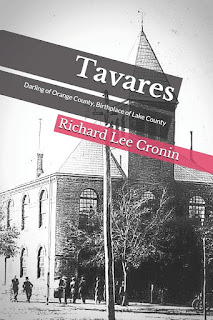
This series also includes research generated while writing my book, Tavares: Darling of Orange County, Birthplace of Lake County. Specifically, Chapter 26, MOUNT DORA: The Eastern Gateway. This book is available now at Amazon.com

CLICK ON BOOK COVER TO BUY IT AT AMAZON

ABOUT MY TAVARES BOOK 

Lake County, established May 27, 1887, was carved from portions of Orange and Sumter counties. The Legislature had defined borders but allowed the 2,200 plus registered voters to decide where to place the county seat. Four elections and a courthouse battle later, Tavares, on August 10, 1888, finally became the official seat. The selection process lasted 440 days from start to finish.

TAVARES: Darling of Orange County, Birthplace of Lake county, is a history of how Florida's Great Lake region transitioned from a wilderness into a vibrant Citrus Belt district. Amazing pioneers dared to dream big - dared to imagine such places as Leesburg, Lady Lake, Mount Dora, Montverde, Eldorado, Eustis, Umatilla, Astor, Clermont, Yalaha and Tavares, to name a few. A section on each place is found in this book.

RATED 5 STARS from Four Amazon verified readers, this is a story of triumph over tragedy; of homesteaders becoming town builders; of steamboats and railroads forging a new homeland, and of remarkable men and women who made it happen. There is even a touch of mystery and intrigue.

The story of the earliest days of settlement of Florida's Lake County, a history you can buy now at Amazon simply by clicking on the book cover above.


Visit my Website at CroninBooks.com

Wednesday, April 7, 2021

MOUNT DORA: The First Mount Dorans - Part Four

 The first Mount Doran’s

Part 4 of my series: a stroll along historic 5th Avenue


Mount Dora Bank & Trust and the Simpson Building

Our stroll down Mount Dora’s 5th Avenue paused in my last installment at the southeast corner of 5th and Donnelly. Having begun a 1,538’ trek westward from Tremain Street, our walk thus far has covered nearly half the distance. One entire city block was the subject of Part 3, but the final half-block, you may recall, was an area I referred to as the start of a “Simpson Territory”. Monroe & Martha (Pike) Simpson, and later their son Otto, owned the half-block stretch from Royellou Alley west to the corner at Donnelly Street.

Today, after we cross Donnelly Street, still following the 1848 footsteps of Surveyor James M. Gould, we resume walking through “Simpson Territory”. James Simpson, a younger brother of Monroe, acquired the southwest corner of 5th and Donnelly – and all land west to Dora Ann Drawdy Alley, on April 22, 1924. This parcel, located in Block 3 of John & Annie Donnelly’s town of Mount Dora, was where the Mount Doran Stowe family had built their residence at the turn of the 20th century. That house was still standing, as best as I can determine, when James Simpson bought the land – but he had something totally different that a personal residence in mind.


Two Simpson brothers owned one entire city block of the southside of 5th Avenue in the mid-1920s, a half-block on each side of Donnelly Street. Soon after buying the Block 3 parcel, James & Edna Simpson conveyed the corner lot at 5th and Avenue. on August 5, 1925, to a new bank. After personally overseeing construction of a new bank building (see photo above), James Simpson served as the bank’s first President.

“When the Mount Dora Bank & Trust Company opens its doors next Monday,” reported Mount Dora Topic of March 25, 1926, “it will be found in new quarters. The work has been under the personal supervision of James Simpson, President of the Bank”. The article went on to say that one of the features of the new building will be “electric lighting”.


James Simpson Building, 5th Avenue, Mount Dora Block 3

Next, adjacent to the bank building, James Simpson built the three-story Simpson Building, a brick structure having a hotel on the upper two floors, and a restaurant plus retail stores on ground level. When walking 5th Avenue in this block look up – where you will see the weathered hotel sign still on display.


Simpson Hotel Sign, 5th Avenue, Mount Dora Block 3


Americans during the Roaring 20s were changing how they traveled, trading trains for personal automobiles. That change also resulted in a shift in the center of downtown Mount Dora, and two Simpson brothers positioned themselves to be at the center of that change.


The Dora Canal completion in 1882 made it possible for steamboats to bring settlers and tourists to a new village of Mount Dora. A town center grew up around the wharf, and the town expanded outward, even more so after the first train arrived in 1886. The depot overlooked the Mount Dora wharf. By the 1920s however, snowbirds and tourists began arriving in Florida by car, many via a ‘Tavares to Mount Dora highway’, aka a route later designated as U. S. Route 441. The road from Tavares came into downtown Mount Dora along the lakeshore and then connecting with 5th Avenue.

The personal automobile therefore shifted the city center of Mount Dora north, toward 5th & Donnelly, where James Simpson had spearheaded the building of Mount Dora Bank & Trust, his hotel, and his brother’s novelty store across Donnelly Street.

Dubbed “old 441” today, 5th Avenue was part of the historic Dixie Highway system, stretching from Michigan’s UP south to Miami Beach - and points in between.


Westbound on Mount Dora's 5th Avenue at Donnelly Street in the 1930s

Above: Mount Dora Bank & Trust on left, Donnelly Building on right


The two-story Donnelly Building, across on the northwest corner of 5th & Donnelly Street, had preceded Simpson’s bank and hotel by nearly a dozen years. It too found new life as cars delivered newcomers to the town. Known as the Mardi Gras Building today, the building was home to numerous restaurants and shops throughout its 110 years at this intersection. Upstairs was divided into four apartments, while on ground level, when James Simpson opened wide the doors to his new bank across the street, Mount Dora Lodge of Free & Accepted Masons, reported Mount Dora Topic, “displayed a new electric sign on the Donnelly Building, corner 5th & Donnelly. The sign is of the flashing type and attracts all.”

The historic Donnelly Building today goes by the name Mardi Gras Building, and is dressed for the name with its handsome New Orleans style ornamental iron exterior. Mount Dora Bank & Trust Building is now at times referred to as the Shamrock Building – named for the building's one-time occupant, Keith Shamrock Realty, who in 1991, acquired the Mount Dora office of Huskey Realty.

And so once again, our 1,538’ stroll along 5th Avenue has advanced only one-half block in this installment. But I do have a good excuse this time. “City Block menaced as Princess Theater burns.” Part 5 of my series will continue once all the smoke clears.


AND NOW, A WORD FROM MY SPONSOR. ME!

This series is created from research for my next book, MOUNT DORA: The First Mount Dorans. I expect the book to be released in November, in time for the holiday gift giving season. Add your name now to receive a signed copy of the book once it is released. PAY NOTHING now, but reserve your copy my emailing me at LakeCountyLakes@CroninBooks.com You will receive one reply confirming your request, but your next email will not be until the book is released for purchase. You can then decide if you want to proceed with buying the book. MOUNT DORA: The First Mount Dorans will be a detailed history of the true origins of Lake County's beloved Mount Dora. 


This series was also created from research generated while writing my book, Tavares: Darling of Orange County, Birthplace of Lake County. Chapter 26 of my book is MOUNT DORA: The Eastern Gateway. 


CLICK ON BOOK COVER TO BUY IT AT AMAZON

 Lake County, established May 27, 1887, was carved from portions of Orange and Sumter counties. The Legislature had defined borders but allowed the 2,200 plus registered voters to decide where to place the county seat. Four elections and a courthouse battle later, Tavares, on August 10, 1888, finally became the official seat. The selection process lasted 440 days from start to finish.

TAVARES: Darling of Orange County, Birthplace of Lake county, is a history of how Florida's Great Lake region transitioned from a wilderness into a vibrant Citrus Belt district. Amazing pioneers dared to dream big - dared to imagine such places as Leesburg, Lady Lake, Mount Dora, Montverde, Eldorado, Eustis, Umatilla, Astor, Clermont, Yalaha and Tavares, to name a few. A section on each place name will be found in this book.

RATED 5 STARS from Four Amazon verified readers, this is a story of triumph over tragedy; of homesteaders becoming town builders; of steamboats and railroads forging a new homeland, and of remarkable men and women who made it happen. There is even a touch of mystery and intrigue.

The story of the earliest days of settlement of Florida's Lake County, a history you can buy now at Amazon simply by clicking on the book cover above.


Monday, April 5, 2021

MOUNT DORA: The First Mount Dorans - Part Three


The first Mount Dorans

Part 3 of our historic stroll along Mount Dora's 5th Avenue


Parkview Building, 5th Avenue, Block 2, Town of Mount Dora

You can buy locally made crafts today at Mount Dora Center for the Arts, where, in November 1954, diners at Peppermint Stick Restaurant enjoyed a traditional Thanksgiving meal, with all the fixings, for $1.50. Afterwards, stuffed patrons could even take home a box of Pink Cottage Candies. The restaurant, on the ground level of 5th Avenue’s historic Parkview Building, often ran ads mentioning they were across from Donnelly Park’s shuffleboard courts. Ice cream is now scooped up next door, whereas way back in 1975, bargain hunters scoured Village Green Antiques in search of that perfect something for their home.


Peppermint Stick Restaurant, June 26, 1975 Mount Dora Topic

The appropriately named Parkview Building turns 100 soon. Built in 1923, the building has a pair of storefronts at ground level and seven (7) rental apartments on a second level. Outside, the dark red brick building appears much as it has throughout the building’s history.

Widower John Donnelly, in 1910, sold the vacant lot to snowbirds Washington & Sarah Tallon of Beaver County, PA. The Tallon’s did not relocate to Florida, but instead held the property for 13 years, selling the undeveloped land in June 1923. Parkview was built that year, and the new owner, William Ingram of Chester, West Virginia, also remained a snowbird. Ingram kept the building as an investment property for 23 years.


Rear of Parkview Building today, down Royellou Alley

The sidewalk out front of Parkview Building is steep, so watch your step if you choose to follow our 1,538’ stroll west in the footsteps - the mission of this series – of Surveyor James M. Gould in 1848. At that time though this was all wilderness, so each new present-day footstep we take is also steeped, pardon my pun, in 175 years of fascinating Mount Dora history.


Alongside Parkview Building on the west is Royellou Alley, halfway point of 1882 Mount Dora’s Block Number 2. This city block runs from Baker Street to Donnelly. A worthwhile side trip is to visit the Historical Museum, down the alley in the back of Parkview Building, but as we are on a historic mission ourselves, we need to continue west, entering a “living history museum” of its own. But to the casual observer the history could easily be missed.


Southside of 5th Avenue, Mount Dora, Sanborn Insurance Survey (1920)

The Sanborn Insurance Company surveyed downtown Mount Dora in 1920. One portion of that survey, the south side of 5th Avenue between Donnelly & Baker Streets, is shown above. Note the small building identified as [A], left (west) of the alley. It is described as a “Dwelling”, and the building still exists today. A restaurant now, this structure was built in 1917. The Parkview Building location, identified by me as [B], is not shown on the survey right (east) of the alley because it was not yet built in 1920. The 1920 survey however does show a structure at the corner of 5th Avenue and Donnelly, identified by me as [C] and noted by Sanborn Insurance as “D. G. Notions”. In 1920 this was a Dry Goods notions store.

West of Parkview Building, west of the alley, our stroll enters Simpson Territory, home to one of Mount Dora’s remarkable pioneer families. The Simpson’s first laid down roots in these parts before John & Annie Donnelly ever platted a town here. In the 1950s and 1960s, a descendant, Otto M. Simpson, operated his Simpson Realty here at 116 E. 5th Avenue. But a quarter century prior to Otto selling real estate here, his parents, Monroe & Martha Simpson, listed their home address as 112 E. 5th Avenue. That same year, 1926, Simpson & Son was listed as the dry goods and notions store at 422 Donnelly Street, at the corner of 5th and Donnelly.

Keep in mind we have not yet crossed Donnelly Street, where we will again encounter more of the Simpson family property.

I first wrote of the Simpson’s in my Orlando Lakes: Homesteaders & Namesakes. In 1890, the official Orange County map of that year identified a large lake on the line separating Lake and Orange County as Lake Simpson. Milton and son David Simpson had homesteaded 320 acres on this lake in the late 1870s. And grove owner M. M. Simpson is mentioned as a Mount Dora pioneer in my, Tavares: Darling of Orange County, Birthplace of Lake County. David & Mollie Simpson, landowners near Lighthouse Park, are also mentioned in my Tavares book.


Lake Simpson, upper right corner of this 1890 Orange County


Then too, John A. MacDonald, author of the 1882 publication, Plain Talk about Florida, told of how he had tried to “induce” a friend to buy the Simpson Place (near Lighthouse Park) in 1880 at $3,600. MacDonald’s friend backed out, so John then partnered with a gentleman named Alexander to buy the place.

My point for now is this, one cannot tell the story of Mount Dora without mentioning the name Simpson – and doing so often!

Meanwhile, back at 5th and Donnelly Street, Monroe Simpson had married Martha Pike, and this enterprising couple had a son. Otto, who was born at the turn of the 20th century - likely right here at 5th and Donnelly Street.


 Looking west toward Lake Dora from 5th and Donnelly Street (1930) Florida Memory Project


We now have traveled nearly 12 chains in the first three parts to this series. That is about half the distance of 23.30 survey chains, the distance James M. Gould traveled in 1848. Seems like a good place to take a break as well. Next, in Part 4, we will venture across Donnelly into more of the Simpson territory and more of the First Mount Dorans. See you then!


This series is created from research for my next book, MOUNT DORA: The First Mount Dorans. I expect the book to be released in November, in time for the holiday gift giving season. Add your name now to receive a signed copy of the book once it is released. PAY NOTHING now, but reserve your copy my emailing me at LakeCountyLakes@CroninBooks.com You will receive one reply confirming your request, but your next email will not be until the book is released for purchase. You can then decide if you want to proceed with buying the book. MOUNT DORA: The First Mount Dorans will be a detailed history of the true origins of Lake County's beloved Mount Dora. 


This series was also created from research generated while writing my book, Tavares: Darling of Orange County, Birthplace of Lake County. Chapter 26 of my book is MOUNT DORA: The Eastern Gateway. 


CLICK ON BOOK COVER TO BUY IT AT AMAZON

 Lake County, established May 27, 1887, was carved from portions of Orange and Sumter counties. The Legislature had defined borders but allowed the 2,200 plus registered voters to decide where to place the county seat. Four elections and a courthouse battle later, Tavares, on August 10, 1888, finally became the official seat. The selection process lasted 440 days from start to finish.

TAVARES: Darling of Orange County, Birthplace of Lake county, is a history of how Florida's Great Lake region transitioned from a wilderness into a vibrant Citrus Belt district. Amazing pioneers dared to dream big - dared to imagine such places as Leesburg, Lady Lake, Mount Dora, Montverde, Eldorado, Eustis, Umatilla, Astor, Clermont, Yalaha and Tavares, to name a few. A section on each place name will be found in this book.

RATED 5 STARS from Four Amazon verified readers, this is a story of triumph over tragedy; of homesteaders becoming town builders; of steamboats and railroads forging a new homeland, and of remarkable men and women who made it happen. There is even a touch of mystery and intrigue.

The story of the earliest days of settlement of Florida's Lake County, a history you can buy now at Amazon simply by clicking on the book cover above.


Wednesday, March 24, 2021

MOUNT DORA: The First Mount Dorans - Part TWO


The first Mount Dorans – Part 2


City Hall, inspired by the historic ‘Guller House’


Perhaps he went next door to borrow a cup of sugar from a neighbor, but however John met Annie, the two married in 1882. John Donnelly and Annie Stone became neighbors the month she sold ten acres of her 1878 homestead in June of 1881. Annie’s homestead became Mount Dora, and 13th Avenue of today was the north boundary line of her property. John P. Donnelly bought the land on the north side of 13th Avenue, closing on that purchase June 4, 1881.

Unlike Annie’s choice property, Donnelly’s land did not have Lake Dora frontage. His land did however border the Hawley property to the east, namesake of Mount Dora’s original north-south Hawley Street. In 1882, Hawley Street became the east line of the newly established town of Mount Dora. The street name changed to Tremain soon after the death of pioneer Ross C. Tremain (1841-1912).

As late as 1920, Sanborn Insurance Company surveys referenced “Hawley Street”, but then, the Mount Dora City Directory of 1924 listed the resident at the “southwest corner of 5th Avenue and Tremain” as Albert & Amy Waltz (see below exhibit). In survey lingo, this could also be called the “Northeast corner of Section 31” – where our westbound 5th Avenue walk begins.

Mount Dora 1926 City Directory


Albert J. Waltz was described in 1924 as Chamber of Commerce President and Mount Dora Mayor. Waltz, “a valued citizen” said Mount Dora Topic when reporting his death in 1954, had been a prominent citizen throughout his four decades as a Mount Doran. A home builder prior to leaving Medina, Ohio, the Waltz family came to Mount Dora in 1911. His obituary described him as a builder who had “constructed many of the city’s residences and business buildings and established the Mount Dora Builders Supply company.” His A. J. Waltz Company, in 1926, was awarded the job to expand the historic Lakeside Inn – Florida’s oldest continuous operating hotel today. Albert was also a charter member of the Mount Dora Historical Society.

To the west of the Waltz residence, at the corner of 5th & Baker, stood the original Methodist Church of Mount Dora (see 1895 photo below, courtesy the Methodist website). Organized in 1882 with twelve members, the members first worshiped at the schoolhouse according to a history of the Mount Dora Methodists published in 1940. The church building as shown was begun in 1883, but construction was slow, and the membership finally dedicated the new organ in 1888. The church was reportedly completed finally in 1896, and in 1912, the year the Albert Waltz moved in next door, electric lights were added in the church building. (Albert was also said to be active in the Methodist Church).


Sanborn Insurance Company survey of 1920 at right above 


August 1940 saw the final church service at 5th and Baker, and subject to requirements of the property buyer, demolition began the following day. Sunoco Gas Station, opened in 1941, was run first by E. C. Frost prior to being acquired later in 1941 by James E. Avery.

America became involved in the World War that year, and within a few years, a young Naval Petty Officer attached with the First Marines landed on Guadalcanal. “He is a survivor of three torpedoed vessels and was also wounded while on Guadalcanal,” reported Mount Dora Topic of September 20, 1945. Twice he received a Presidential citation before returning to the States for medical care. “He liked Mount Dora when he passed through the town from hospital to hospital and stopped overnight at cabins.” After being all around the world, Petty Officer Jerry Morgan chose Mount Dora to live, and in September 1945, acquired the Sunoco Station at the corner of 5th and Baker.

Today, Sun Bank occupies land where once stood Jerry Morgan’s Sunoco Station. The bank also sits on land where once stood the home of Mount Dora Mayor, Albert J. Waltz.


Sanborn Insurance 1912 survey of Mount Dora Town Block 60 and 61

Block 60 is currently Donnelly Park in downtown Mount Dora


Mayor Waltz would have had a short commute since City Hall sat across 5th Avenue from his residence. Remembered historically as the Guller House, Mount Dora City Hall occupied one of the first homes ever built in John & Annie Donnelly’s town of Mount Dora.

Henry Guller (1847-1919) had been an 1880 neighbor of Annie Stone and John Donnelly. In fact, the Donnelly’s sale to Henry Guller occurred so early in the organization of the city that the parcel was not described by a lot number. Filed at Orange County, the parcel was instead described as the: “SE ¼ of the SE ¼ of the SE ¼ of SE ¼ of Section 30”, less a right of way allowance on each of the four sides for public roads. The Guller House today is known simply as located in “Block 61” (Note 1912 survey of Guller House with "Windmill" in Block 61 above).

Like that of the old Methodist Church of 1940, City Hall, aka Guller House, was also demolished.  A new City Hall, “similar in style and appeal,” wrote Jacqueline Bowman in 1964, was dedicated April 13, 1964. The new City Hall incorporated into its design the original Guller House columns.


Mount Dora City Hall, Then and Now


Today, Mount Dora City Hall continues to grace the entire north side of 5th Avenue, or Block 61, across from Block 1, but City Hall faces Baker Street, in a block long used as a gathering spot for Mount Dorans. Thousands had gathered here, reported the Mount Dora Topic of November 7, 1929, the prior Saturday evening – there to enjoy the first annual Mount Dora Halloween Frolic. “The Parade began,” said the newspaper, “on Baker Street in front of City Hall.”

Cited as “the most unique and comical entry” in the Halloween Parade was a 1914 vintage Ford “carrying two tin-can tourists from the frozen North to the glorious sunshine in Florida.”

Reality of the stock market crash of only a few days prior had yet to register among those who attended the Baker Street festivities, and Baker Street is also where we will gather next, in Part Three of, The first Mount Dorans.


This series was created from research generated while writing my book, Tavares: Darling of Orange County, Birthplace of Lake County. Chapter 26 of my book is MOUNT DORA: The Eastern Gateway. 


CLICK ON BOOK COVER TO BUY IT AT AMAZON

 Lake County, established May 27, 1887, was carved from portions of Orange and Sumter counties. The Legislature had defined borders but allowed the 2,200 plus registered voters to decide where to place the county seat. Four elections and a courthouse battle later, Tavares, on August 10, 1888, finally became the official seat. The selection process lasted 440 days from start to finish.

TAVARES: Darling of Orange County, Birthplace of Lake county, is a history of how Florida's Great Lake region transitioned from a wilderness into a vibrant Citrus Belt district. Amazing pioneers dared to dream big - dared to imagine such places as Leesburg, Lady Lake, Mount Dora, Montverde, Eldorado, Eustis, Umatilla, Astor, Clermont, Yalaha and Tavares, to name a few. A section on each place name will be found in this book.

RATED 5 STARS from Four Amazon verified readers, this is a story of triumph over tragedy; of homesteaders becoming town builders; of steamboats and railroads forging a new homeland, and of remarkable men and women who made it happen. There is even a touch of mystery and intrigue.

The story of the earliest days of settlement of Florida's Lake County, a history you can buy now at Amazon simply by clicking on the book cover above.

Monday, March 22, 2021

MOUNT DORA: The first Mount Dorans - Part One


Enchanting Mount Dora, Florida


Much has been written of the origin of enchanting Mount Dora, but how accurate are the traditional beliefs about Lake County’s charming village along the east shore of Lake Dora? Today, a leisure stroll of 1583 feet can provide many surprising answers about the FIRST Mount Doran’s, and so I invite you to join me on just such a stroll - a walk of 1583 feet along 5th Avenue in downtown Mount Dora. I will even do the walking, so all you need do is sit back, relax, and enjoy reading about 175 years of Mount Dora's fascinating history. And awaiting us at the end of this southbound 5th Avenue stroll is a true story that is bound to astonish you.

First steps of the FIRST Mount Doran:

Our walk begins at a place which will seem, at first, an unlikely starting point. None-the-less, to fully appreciate the town’s real origin, our walk of 1,538 feet needs to commence at the crossroads of 5th Avenue & Hawley Street. If you do not recognize the latter street name it is because the road now goes by the name, Tremain Street.

There are no retail stores to be found at this intersection, and the oldest existing structure here was not built until 1940. Still, 5th & Hawley is vital to the telling of Mount Dora’s history, for the area’s first-ever recorded footsteps occurred at this exact spot. Here? Yes, here!

I began at the northeast corner of Section 31” was the exact sentence penned 173 years ago by Surveyor James M. Gould. Believe me, I have no intention of making a land surveyor out of you, but the importance of Gould’s 1848 notation cannot be overstated in its relationship to the founding of a town 33 years later. The exact spot Surveyor Gould was writing about in 1848 is now the intersection of 5th Avenue & Tremain Street. And you need not rely merely on my word for that fact.

The Lake County Property Appraiser identifies each corner of 5th & Tremain as located in a different "Survey Section”. The northwest corner, says the Appraiser, is in Section 30, whereas the northeast corner is in Section 29. A law office on the southeast corner is, according to the County appraiser, in Section 30, while the bank on the southwest corner is in Section 31. To be more specific, the bank is in “the northeast corner of Section 31.” I've added a survey of the four corners below, which I'll get to in a moment. 

Surveyor James Gould, in 1848, added that after starting at the northeast corner of Section 31, he then began walking “23.30 chains,” the equivalent of 1,537.8 feet, due west to “Lake Dora.” If one desired to duplicate Gould’s walk today, as I plan to do in this series, it would be relatively easy – walk west – downhill -on 5th Avenue until you reach the Lake Dora shoreline.

Of importance is this: the Survey completed in 1848 became the source for writing a homestead deed thereafter. In fact, thirty-four years after Surveyor Gould wrote of the northeast corner of Section 31, a different surveyor, paid to stake out a new town, identified this same spot as “Block One of the Town of Mount Dora.” A square known as Block One today is nearly identical to Block One of 1882. The only significant difference is Baker Street of today was Hawley Street back in 1882.

You now know where our 5th Avenue stroll begins. Remote wilderness in 1848, our walk of 1,537.8 feet today heads west to Lake Dora, but all along the way is a rich history of the earliest days of this town. This series intends to share that history, and then, upon reaching the lake, I will challenge the validity of the traditional “legend” about the naming of Lake Dora.

Annie – the SECOND Mount Doran:

Land west of 5th Avenue & Tremain Street, prior to the town of Mount Dora being established, belonged to one of the bravest frontierswomen of 19th century central Florida. Her name was Annie Stone, and in 1880, it did not matter if you looked north, south, or west from today’s intersection of 5th & Donnelly, you would still be gazing on Annie Stone’s Homestead of 182 lakeside acres.

Talk about a lady worthy of recognition during Women's History Month!

It was Annie, not John P. Donnelly, who established a town at this location. Annie Stone’s town however was named Glencoe. Now, I realize such a statement is contrary to traditional history, but then, such is often the case when it comes to researching central Florida’s true history. 

And I do not expect you to accept my historical version as accurate without proving such a claim.

1848 survey versus Annie Stone Homestead of 1878-1883


So, first, allow me to remove all doubt about my claim, a task easily accomplished. My exhibit above shows James Gould’s survey of 1848 twice. The left side is the survey as James Gould sketched it. The right side has a few notations to assist in better understanding his document. 

My red arrow above points to where the intersection of 5th & Tremain is today. Note how Sections 29, 30, 31 and 32 converge at this spot. Section 29, northeast of the intersection, is shown to be one mile by one mile, as is Section 32 below it. Sections 30 and 31 both have less than a square mile of landmass, that is because of Lake Dora.

James Gould’s survey of 1848 was used as reference in 1883 to write a homestead deed to Annie E. Stone after she had completed a five-year residency requirement, which places Annie Stone on the lakeshore of Lake Dora as of 1878. Using the 1848 survey, Annie was deeded the land I outlined in orange, property described as being the south half Section 30, and all of the landmass in Section 31 of Township 19 South, Range 27 East.

The line dividing Section 30 and 31 on Gould’s survey became Mount Dora’s 5th Avenue in 1882.

Annie Stone herself wrote a deed June 30, 1881 for a sale of part of her homestead. That deed has the following language: “Block #23 in Section 30, Township 19 South of Range 27 East, in the town plat of Glencoe as laid out on Mrs. Annie Stone’s Homestead in Orange County.” (As of 1881, Mount Dora was still part of Orange County).

After selling a small parcel of her homestead in 1881, Annie married John P. Donnelly, and in March 1882, newlyweds John & Annie Donnelly issued another deed having this language: “In a plat of a village on the Homestead of said Annie E. Stone in Section 30, Township 19 South of Range 27 East.” 

On the exhibit above, the Section 30 number is circled in red for your convenience in locating. 

Fast forward to present day, and 13th Avenue is the north boundary of Annie’s Stone’s 19th century homestead. To the south, historic Lakeside Inn, built in 1883, occupies part of Annie’s original 182 acres. Annie owned nearly one mile of Lake Dora shoreline when she married John P. Donnelly, the one pioneer most often cited as founder of Mount Dora.

Her residence and grove are nearly a half mile north of Mount Dora,” said a traveling reporter in 1882 in describing the home of newlywed Mrs. Donnelly, “but stands on ground high above the water, and the path from house to lake is a perfect little Eden of trees, vines, and moss a la nature.” This was the original home Annie Stone, not the historic Donnelly House of Mount Dora built on Donnelly Street in 1893. The original wharf was described as being near Lakeside Inn, so a half mile north would place her residence north of 5th Avenue.  

Annie (McDonald) Stone – Donnelly (1849-1908)

Born 1849 at Wood County, Ohio, Annie McDonald first married William Stone. After the birth in 1856 of Nellie, a daughter, the Stone family relocated to Louisville, Kentucky, where William worked as a railroad clerk. By 1880, Annie was divorced and residing on her homestead at Lake Dora, while a nearby neighbor, John P. Donnelly, had just settled on his land.

Lake Dora of 1880 was not easily reached. The nearest train was at Fort Mason, and the first train had finally arrived that spring. It was a long difficult 1881 land journey from Fort Mason to Annie Stone's Glencoe, but then, in 1882, the Dora Canal was dredged. Larger steamboats could navigate the canal to reach the new town of Tavares, and Lake Dora introduced travelers as well to Glencoe – aka Mount Dora.

Fifth and Tremain 

Intersection of 5th & Tremain Street, Mount Dora

And so, as we look west from the crossroads of 5th & Tremain, aka 5th & Hawley of 1882, we now know our downhill westbound stroll will be crossing land first owned by Annie (McDonald) Stone, an amazing 19th century frontierswoman, and mother of a child not yet a teen when she first arrived in the wilderness of western Orange County. The same property, in 1882, became jointly owned by Annie’s groom, Mr. John P. Donnelly of Pennsylvania.

It is time to get moving, and as there is no better way to be greeted at any town than by the Mayor and or Chamber of Commerce President, this will be our greeting in the next segment of this series. One and the same, a Mount Dora Mayor and Chamber President lived here at the southwest corner of 5th and Tremain. A bank is here now, where James Gould began his walk west in 1848, and where we will begin our walk wet when The First Mount Dorans resumes in Part 2.

This series was created from research generated while writing my book, Tavares: Darling of Orange County, Birthplace of Lake County. Chapter 26 of my book is MOUNT DORA: The Eastern Gateway. 


CLICK ON BOOK COVER TO BUY IT AT AMAZON

 Lake County, established May 27, 1887, was carved from portions of Orange and Sumter counties. The Legislature had defined borders but allowed the 2,200 plus registered voters to decide where to place the county seat. Four elections and a courthouse battle later, Tavares, on August 10, 1888, finally became the official seat. The selection process lasted 440 days from start to finish.

TAVARES: Darling of Orange County, Birthplace of Lake county, is a history of how Florida's Great Lake region transitioned from a wilderness into a vibrant Citrus Belt district. Amazing pioneers dared to dream big - dared to imagine such places as Leesburg, Lady Lake, Mount Dora, Montverde, Eldorado, Eustis, Umatilla, Astor, Clermont, Yalaha and Tavares, to name a few. A section on each place name will be found in this book.

RATED 5 STARS from Four Amazon verified readers, this is a story of triumph over tragedy; of homesteaders becoming town builders; of steamboats and railroads forging a new homeland, and of remarkable men and women who made it happen. There is even a touch of mystery and intrigue.

The story of the earliest days of settlement of Florida's Lake County, a history you can buy now at Amazon simply by clicking on the book cover above.